LISTEN · PODCAST EPISODE 5 · 12 MIN
Boredom Has a Button
Every empty minute in the day now has a phone in it. This lesson shows the reach for it as a loop you can see, and leaves you one place to keep for yourself.
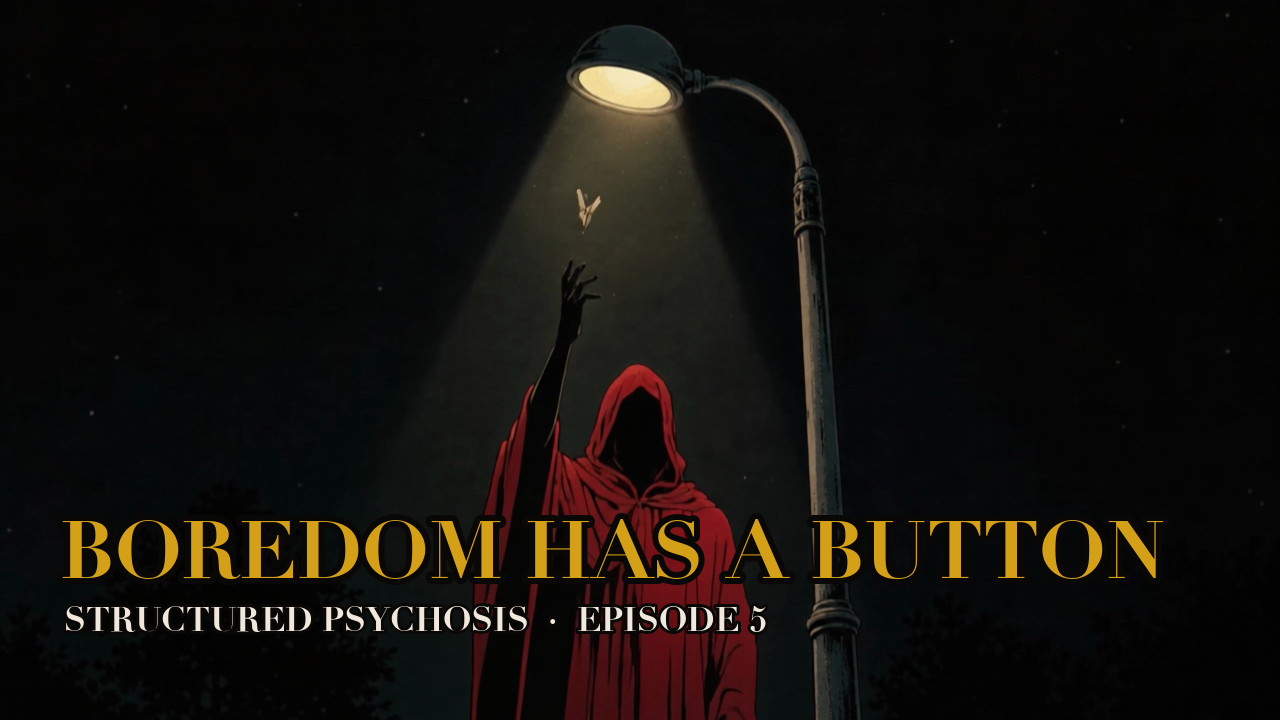 Listen on YouTube · 12 minutes
A note: this episode has some rough words in it. This page has none.
You are in the break room. Your lunch is in the microwave for two minutes. Your phone is out before the plate turns once.
You did not decide that. A gap opened and your hand filled it.
This episode is about that gap: what moved into it, what the reach is covering, and what to do about it.
It sounds like an episode about phones. It is about attention.
Empty time was a place
The episode is two voices at a table. One is Athanor, a made voice. A person wrote its lines. The other is the Red Mage, the school's teacher character.
Athanor describes the time before the phone. A waiting room with old magazines and a clock you could hear. A kid on a bike whose one rule was to be home when the streetlights came on.
The claim is not that it was better. The claim is that the time was empty. Nothing came in.
Now boredom has a button. A gap opens and the hand goes to it. The bathroom. The elevator. The red light.
Then the list changes. Lonely. Uncomfortable. Not sure what to think. It runs to eight. The Red Mage adds a ninth: the moment you almost said something to someone.
The reach is a loop
Look at the second half of that list. Those are not places. They are feelings. The phone is what the hand does about them.
This school has a name for a habit like that: the Devil. Not a creature with horns. In the books, the Devil is your own habits running while nobody is watching. They run as a loop.
The loop is plain, and the reach fits it. Something sets it off: the gap opens. You react without choosing: the hand moves. You get a little relief: the feeling goes quiet for a minute. Then it runs again.
The book's line on the relief step reads like this episode's list.
“The boredom is interrupted. The loneliness is masked. The relief is real but temporary.”
DEVIL: The Hellish Self
The enclosure that never closes
The episode's bigger word is the enclosure. It is never defined there. This page reads it as anything that keeps your attention inside it. School was one. Work is one. The television was one.
The old ones closed. The bell rang. The shift ended. Late at night even the television went to static.
The one in your pocket does not close. Nobody locked it, either. People stood in line to buy it.
The episode says it does something the television never could. It watches back.
The hardest line comes next. The feed does not fix a mood. It matches it. On a lonely night the videos get quieter and sadder, and the watching goes on because they fit. Do not take that on trust. Check it against your own feed.
The book says something close, in a passage about envy, without making the machine a villain. Practitioner is its word for a person who tries these ideas in their own life. Here that is you.
“The algorithm does not know what envy is. It knows what keeps the practitioner scrolling.”
DEVIL: The Hellish Self
What the reach is for
About three minutes in, the Red Mage stops the nostalgia. Athanor never rode a bike. Those memories belong to the person who wrote its lines.
Then the episode turns to the writer. The writer did not choose a childhood either, and did not write those feelings. So where do they come from?
The episode does not answer. It reports what happens next. Each time the writer gets near that question, the hand goes to the phone. The Red Mage answers in six words: that is what it is for.
The school's reading: the reach is not random. It lands where a thought got hard. Test that. Do not just accept it.
One of the books says something close about a body that will not sit still.
“The body that avoids stillness is fleeing something it has not faced.”
MAGUS: The Ontology of One
One place it cannot follow
Near the end, Athanor asks how much of a person you really meet. The Red Mage says it depends on how much of yourself you send.
Then comes the phone itself. Nobody at the table deletes anything. The job is on the phone. The bank is on the phone. So are most of the people you love.
So the question is not whether you own one. It is how much of your day it gets.
The episode's answer is small. You need one place the phone cannot follow you.
They try it on the recording. Ten seconds of nothing. The quiet is strange. When it ends, the phone is still in the hand. The episode does not pretend otherwise.
Why does a school of magick spend an episode on this? Magick, in these books, is not wishing. It is attention, given a structure and applied over time. And the book is blunt: attention is the one thing you steer directly.
“Not outcomes. Not other people. Not the timing of results. Attention.”
MAGICK: The Operations Manual
Words used here
- Athanor
- The school's AI voice at the podcast table. A person wrote its lines, and the memories it describes are that person's.
- the Red Mage
- The school's teacher character. Not a person. It answers in short dry lines.
- the Devil
- The books' name for your own habits running with nobody watching, not for a creature. They run as a loop: trigger, reaction, a little relief, again.
- the enclosure
- The episode's word, never defined there. This page reads it as anything that keeps your attention inside it: school, work, the television, the phone.
- practitioner
- The books' word for a person who tries these ideas in their own life. On this page, that is you.
- magick
- A practice you test in your own life. The books describe it as attention, given a structure and applied over time.
Tonight. Five minutes.
- Put your phone in another room. Sit down with a pen and a sheet of paper.
- Write down three times today when your hand went to the phone for no reason. Just the place: the line, the bathroom, the couch.
- Next to each, write what you felt a second before. One word: bored, lonely, stuck, dreading. A guess counts.
- Count slowly to sixty. Each time you want the phone, make a mark.
- Write one place the phone does not go tomorrow. Only one. The dinner table, the bathroom, the first ten minutes awake.
Tomorrow night, read the paper again. Did the phone stay out of that one place, and what showed up in the gap? Keep what holds. Drop the rest.
Questions to sit with
- When was the last time nothing was happening, and you let it stay that way?
- The ninth reach is the thing you almost said to someone. What was the last one, and who was it for?
- Think of the last person you talked to today. Where was your phone, and how much of you did they get?
This page is the written lesson of the podcast episode. The quoted lines come from the MAGUS books named under each one. Test it in your own life. Keep what holds.
Go deeper.
This lesson ends on attention. The next one says what the school does with it: one sentence for what magick is, then the same sentence slowly, part by part.
New here? The free book has six sections and one practice you can test. Start with MAGICK, An Introduction.